

At a glance
Ostia annotations
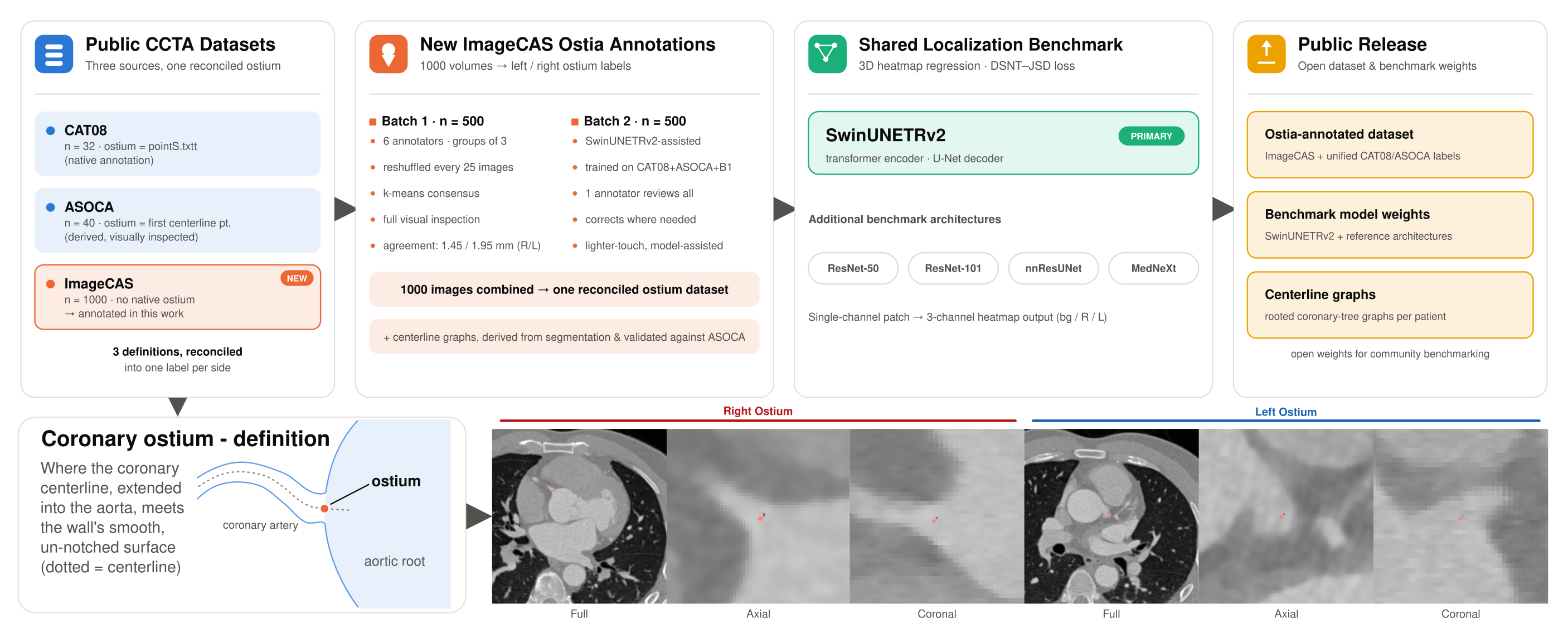
The coronary ostia are the points where the left and right coronary arteries originate from the aorta. ImageCAS provides 1000 CCTA volumes with coronary segmentation masks but no ostium annotation; we add one left and one right ostium landmark to every volume.
- First 500 volumes, manual. Six annotators, in rotating groups of three, consolidated by consensus.
- Remaining 500 volumes, semi-automatic. A model trained on the first batch proposes the ostia, which are then corrected, instead of being annotated from scratch.
- One consistent definition. The annotations are reconciled with the operational definitions of the ostium used by CAT08 and ASOCA, so that the three datasets can be used together.
From annotation to benchmark
How the ostia dataset was assembled and how the benchmark was trained and evaluated, step by step: the two annotation stages, the assistant model, the test set, the benchmark models and the ablation studies. Use the chapter buttons to jump to a step.
Centerline graphs
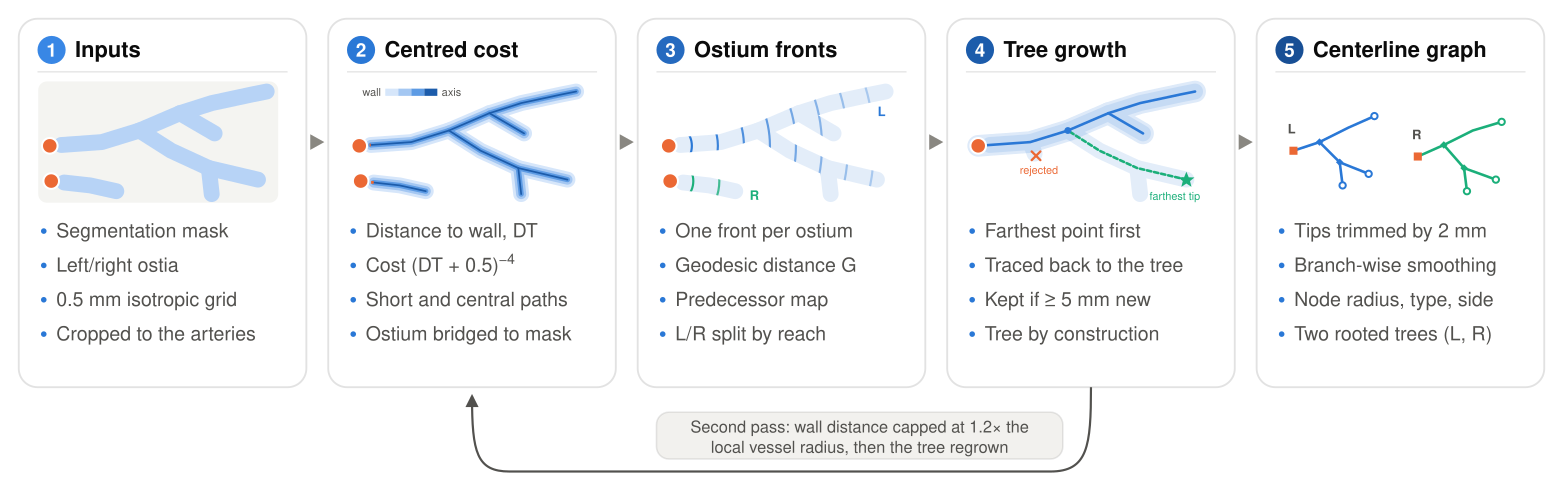
Centerline graphs rooted at the annotated ostia are extracted from the ImageCAS segmentation masks with a deterministic minimal-path tree-growing procedure. They are validated against the expert centerlines of ASOCA.
Centerline tracking, in brief
A simplified 2D illustration of how a centerline tree is traced: from the ostia placed by the model, through the distance to the vessel wall, to the rooted graph.
Centerline tracking, in detail
The same procedure with every step of the pipeline: mask repair, ostium and gap bridging, distance and cost maps, the two minimal-cost fronts, the two growing passes, tip trimming, smoothing and the final typed graph. Use the chapter buttons to jump to a step.
Benchmark
We release open-weight models for automatic ostia localization: SwinUNETRv2, ResNet50, ResNet101, MedNeXt and nnResUNet, trained with a differentiable coordinate-regression loss and evaluated on a test set of 58 volumes from ImageCAS, CAT08 and ASOCA. Errors are graded against thresholds derived from the ostial anatomy and from the variability between annotators.
The best models localized all the ostia without any failure. Median errors are 0.74 mm (right) and 0.85 mm (left) for SwinUNETRv2, and 0.70 mm and 0.87 mm for nnResUNet.
Resources
- Paper: coming soon
- Dataset annotations: coming soon (Zenodo)
- Model weights: coming soon
- Code: coming soon (GitHub)
Citation
Paper
@article{leccardi_awakening_imagecas,
  title   = {Awakening ImageCAS: Automated Coronary Ostia Localization Framework and Centerlines Open Dataset},
  author  = {Leccardi, Matteo and Morandini, Marco and Brembilla, Michele and Nicosia, Alessandro and
             Penserini, Andrea and Brandini, Christian and Marcon, Marco and Moglia, Andrea and
             Mainardi, Luca and Cerveri, Pietro},
  note    = {Under review}
}
Dataset (Zenodo)
@dataset{leccardi_awakening_imagecas_dataset,
  title     = {Awakening ImageCAS: coronary ostia and centerline annotations for ImageCAS},
  author    = {Leccardi, Matteo and Morandini, Marco and Brembilla, Michele and Nicosia, Alessandro and
               Penserini, Andrea and Brandini, Christian and Marcon, Marco and Moglia, Andrea and
               Mainardi, Luca and Cerveri, Pietro},
  publisher = {Zenodo},
  doi       = {10.5281/zenodo.XXXXXXX},
  note      = {DOI placeholder}
}
Original ImageCAS dataset
Our annotations extend ImageCAS: please also cite the original dataset paper.
@article{zeng2023imagecas,
  title   = {ImageCAS: A large-scale dataset and benchmark for coronary artery segmentation based on computed tomography angiography images},
  author  = {Zeng, An and Wu, Chunbiao and Lin, Guisen and Xie, Wen and Hong, Jin and Huang, Meiping and
             Zhuang, Jian and Bi, Shanshan and Pan, Dan and Ullah, Najeeb and Khan, Kaleem Nawaz and
             Wang, Tianchen and Shi, Yiyu and Li, Xiaoming and Xu, Xiaowei},
  journal = {Computerized Medical Imaging and Graphics},
  volume  = {109},
  pages   = {102287},
  year    = {2023},
  doi     = {10.1016/j.compmedimag.2023.102287}
}
ImageCAS-X
@misc{bransby2026imagecasx,
  title         = {ImageCAS-X: a dataset and benchmark for coronary artery segmentation and centerline extraction in coronary CT angiography},
  author        = {Bransby, Kit M. and {\O}ksnebjerg, Esther and Kj{\ae}r, Kristoffer and Kirkeby, Jacob and
                   El Youssef, Yasmin and Jim{\'e}nez, A{\"i}da and Pedersson, Philip R. and
                   de Knegt, Martina C. and Kofoed, Klaus F. and Paulsen, Rasmus R.},
  year          = {2026},
  eprint        = {2608.30404},
  archivePrefix = {arXiv},
  primaryClass  = {cs.CV},
  url           = {https://arxiv.org/abs/2608.30404}
}